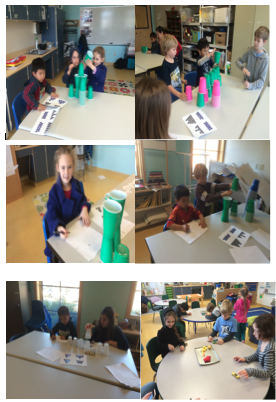
Below you can find a summary of what the kids did in science and garden classes in the Winter trimester.
Next trimester we are having our first science fair at Peregrine elementary. I am really excited, and will share more details about what the kids will be doing soon.
Owls
I covered the Kindergarten physical
science standard this trimester. The overall focus of this standard is forces
and motion. The kids had a lot of fun
exploring pushes, pulls, collisions, friction and gravity. Before diving into
the study of forces and motion, I did a few simple activities to introduce the
idea of programming to the kids. Peregrine is starting to integrate engineering
and programming to the elementary curriculum. If you are interested in learning
more about the importance of introducing these concepts to curriculums, and
don’t have much time to research this topic, I recommend the New York Times
article “Adding coding to the curriculum”. The kink to this article is: http://www.nytimes.com/2014/03/24/world/europe/adding-coding-to-the-curriculum.html?_r=0
After writing codes for their friends to
build cup stacks, the owls played with Kodable – a program that teaches kids
how to code.
We started this physical science unit
by exploring ways in which we can make things move. After letting the kids
explore (in classroom with toys and ramps and at the park), it was clear that
the kids knew that pushes and pulls make things move and that they can have
different strengths and directions. The kids also learned that pushing or
pulling on an object can change the speed and/or direction of its motion and
can also start or stop it.
Since the kids clearly understand the
Kindergarten physical science national standard, we went a little deeper into the
study of motion. The kids learned about friction, collisions and gravity. I
brought hover pucks to school to illustrate the concept of friction and the
kids compared how fast things move on different surfaces. To illustrate what
happens to objects when they collide, I asked the students to collide objects
in different scenarios – objects moving in opposite direction, objects moving
in same direction and when one object is stationary and the other moving. We
also read books about gravity, and some kids were very interested in learning
about Earth’s gravitational pull. The kids were engaged and had fun exploring
motion.
Our final project was building a
miniature golf course. We started by watching a short video (2 minutes) with an
example of a homemade miniature golf course and discussing the materials and
forces involved in the example. The kids were able to identify different types
of pushes, gravity and friction. Then each student drew a possible design for a
hole and created a model in the classroom. After everyone had a chance to think
about the design and forces involved in this game, I brought wood and other
materials for the kids to build their own mini golf course.
In “garden” classes, the owls harvested
vegetables from their garden and made their own juice. Students participated in
every step: they planted, harvested, washed, cut and added ingredients to the
juicer. In addition, the kids also helped me take care of the school garden
(pulling weeds, planting seeds and seedlings and adding to the compost) and we
also went on nature walks.
Magpies
During the second trimester the first
and second graders studied physical sciences. The focus of the standards that I
covered this trimester was on sound and light. The kids also learned about the
states of matter, and practiced asking questions.
We started this trimester studying
sound. The two main questions that we answered were: what is sound/what makes
sound and how does sound travel. The kids had a lot of hands on activities to
explore sound – they made string telephones with different types and length of
strings, they simulated sound waves with slinkies, made sound in different
places – including inside water, on something solid and in the air. We were
also fortunate to be able to borrow a Ruben’s tube from UC Davis Physics
Department – the kids love seeing the fire “dance” with the music, and it leads
to great discussions on sound waves. They can see the waves as the shape of the
flame changes with the music.
I used the kids’ observations of sound
traveling through different sources to initiate a discussion on matter. Some
kids were familiar with the word and its meaning, while others were learning
for the first time. We talked about the difference between energy and matter,
and I explained that matter is made of small units called atoms. After this I
did a few demonstrations and hands on activities to allow the kids to explore
and understand the different states of matter.
Our next, and last, topic of the
trimester was light. Our study started with a shadow hunt. Each student had a
small LED light and was asked to go on a shadow hunt for a few minutes. The
goal of this activity was to get the kids thinking about light and shadows so
that I could hear from them – theirs thoughts and questions. One of the great
things about working at Peregrine is that I can go much deeper into the
subject, and can (usually) answer everyone’s questions.
The kids learned that light is a form
of energy, and that the different colors that we see correspond to different
wavelengths. They also know that there are natural and man made sources of
light. Each student had a chance to demonstrate one way in which light
interacts with things in the classroom. Some showed us how light reflects from
a mirror, passes through a clear bag and is absorbed by the carpet.
In order to answer students’ questions
we also talked about Earth’s interaction with the sun – we demonstrated how the
planet moves around the sun with a focus on explaining why the day has 24 hours.
We made sundials, watched a short documentary on Thomas Edison and built simple
circuits to demonstrate energy transfer and how a light bulb works.
In “garden” classes, the magpies continue to be very
busy taking care of the garden. They harvested and transplanted vegetables, picked
weeds, and planted strawberries and trees. The magpies also started planning
what to plant after spring break.
Hawks
The third and fourth graders studied life science this
trimester. We started the trimester making a connection between what they
studied in the first trimester (geology, how California was formed) and living
things. We looked at examples of changes in the landscape that happened after
the formation of California. Examples included invasive alien plant species
changing the landscape and the hydrological changes that accompanied the
expansion of our state.
In order to make biology more engaging and attractive to the
kids, I brought a class pet (leopard gecko) and small vernal pools to their
classroom. The kids learned how to take care of the geckos – they know what
they eat, when they eat, how they protect themselves, where they live (natural
habitat), their ideal temperature and how to determine their genders. The kids
enjoy seeing the geckos eat crickets and mealworms. We also got to see the
mealworm life cycle – most kids were surprised to see that they turn into
beetles!
Vernal pools are fascinating – this unique ecosystem can be
used to study ecology, evolution and microscopy. After getting a general
understanding of what vernal pools are (temporary pools that come to live
during the rainy season), we started adding water to our pools and collecting
data. The kids observed that algae and plants were the first life forms to
appear in the pools, and they noticed that they grew faster in the indoor pools. Students also had a chance to practice
reading temperatures in a thermometer since they would always check the water
temperature when collecting observational data on the pools.
The vernal pool study lead us to a discussion on evolution
of life in our planet, so we watched a National Geographic documentary on the
evolution of life on Earth. The documentary starts with the formation of our
planet, it also talks about the formation of our moon, and then it summarizes
how Earth’s atmosphere changed to become inhabitable. The documentary then focuses on the evolution
of life - from the simplest unicellular
organisms in the ocean, to complex aquatic and terrestrial animals, ending on
humans.
After watching this documentary and having a few class
discussions on evolution, I brought different microscopes to the classroom and
showed the kids how to use them. This led us to discussions on the ecology of
vernal pools – we talked about vernal pool food web, and took a close look at
what and how fairy shrimp eat.
The last project for this unit was an animal research
project. Each student chose one animal that they would like to learn more
about. I wrote down some questions that I wanted them to answer, and Sangeeta
and I helped the kids find good resources for their research. They looked at
websites, found books at the library and some learned information at the Zoo,
during their field trip. The kids did a great job answering the questions and
creating posters summarizing what they learned.
Even though the kids learned a lot this trimester, I would
like to finish this unit after spring break. I want to do a few quick activities
to ensure that the kids understand the concept of evolution and want to focus a
little more on plants. Students were so engaged in the animal study that we
ended up not looking at structures/functions of plants. I will probably spend 1
– 2 weeks finishing our life science study before we move on to our next topic.
In “garden” classes, the hawks were introduced to their
landscape design project. The third and fourth grades class will be responsible
for designing a native area in our yard. Lorie Hammond is acting as a client,
and the hawks are the landscape architects for this project. She told them that
the school wants to develop a native area that future 3rd and 4th
grades students can use when studying California. The kids are responsible for
learning about the native plants that they want to include in the native area
and designing a plan for it. The plan has to include the relative size and
microhabitat (how much sun and water it needs) of each species. Students had
the opportunity to see natural, native CA habitats by the school and in the UC
Davis Arboretum. Now they are starting to research the different species that
they want to include in their project.
Crows
During the second trimester, the fifth
and sixth graders studied chemistry. We started with a fun activity – I asked
the kids to go outside and find 3 or 4 random things, they could even collect
liquids with small vials. After each group presented their items, I asked
students to guess what everything in the classroom had in common. It took them
a while but eventually someone said, “They are all made of matter”.
We had a good discussion about matter
and atoms. The kids clearly understand that atoms are the building blocks of
our universe, but most of them didn’t know what an atom is. We built models of
atoms, talked about all the parts and watched a short Bill Nye video about
atoms and molecules. Students also had the opportunity to build models of
molecules. We talked about the periodic table, and the kids used different
colors to represent the elements that they wanted to use to build their
molecules.
It was clear to me that the children
understood that molecules are made out of elements, so we moved on to study
reactions. My goal was to make sure that they understood that no atom is
created or destroyed in a chemical reaction – atoms are just rearranged. In
order to demonstrate this, I started with a simple, well-known reaction:
vinegar and baking soda. I wrote down the chemical formula for each reactant,
had the kids observe each reactant (look, smell, touch) and then asked them to
mix them. It was clear to everyone that a chemical reaction had occurred – the
products looked much different than the reactants. The kids knew that a gas had
been produced during the reaction and most guessed (right) that it was CO2. After
writing the molecular formulas for the reactants and products, the kids could
clearly see that there were the same numbers of atoms before and after the
reaction. The atoms had just been rearranged into new molecules.
Now the kids were ready for a fun inquiry activity involving
chemical reactions. After being assigned into groups, students were asked to
mix specific amounts of calcium chloride, baking soda and phenol red solution
in a zip lock bag. The mixture got really hot, changed color and produced a
large amount of gas. The kids’ job was to find out what was causing the heat in
this reaction. Each group had to design two experiments to try to answer this
question and at the end they were asked to write a lab report summarizing the
experiment.
In “garden” classes, the crows started to work on their
landscape design project. The 5th and 6th graders learned
about the elements of a Greek/roman garden, measured the area that they have
available for this project and started to draw a detailed map with their ideas
for an “educable and edible” Mediterranean garden that future 5th
and 6th graders can use when studying ancient civilizations. The design includes an orchard, an
amphitheater and ornaments. Each group will present their ideas and everyone
will vote to decide the final design. In addition, the crows planted trees
around the school and helped me take care of the garden.
During health classes the crows continued studying
nutrition. The kids started this unit learning more about what their bodies
need. After finding out how many calories, and how many grams of protein and
fat they need on a daily basis, the kids were asked to look at the nutritional
information of some of their favorite foods. Their assignment was to make a few
pie charts summarizing how much of the daily nutritional need they get with a
meal of their choice.
After completing this assignment, we talked about sugar. The
kids measured the amount of sugar in different snacks and we talked about the
difference between natural and added sugars. Students clearly understand that added
sugars are a problem in our society.